

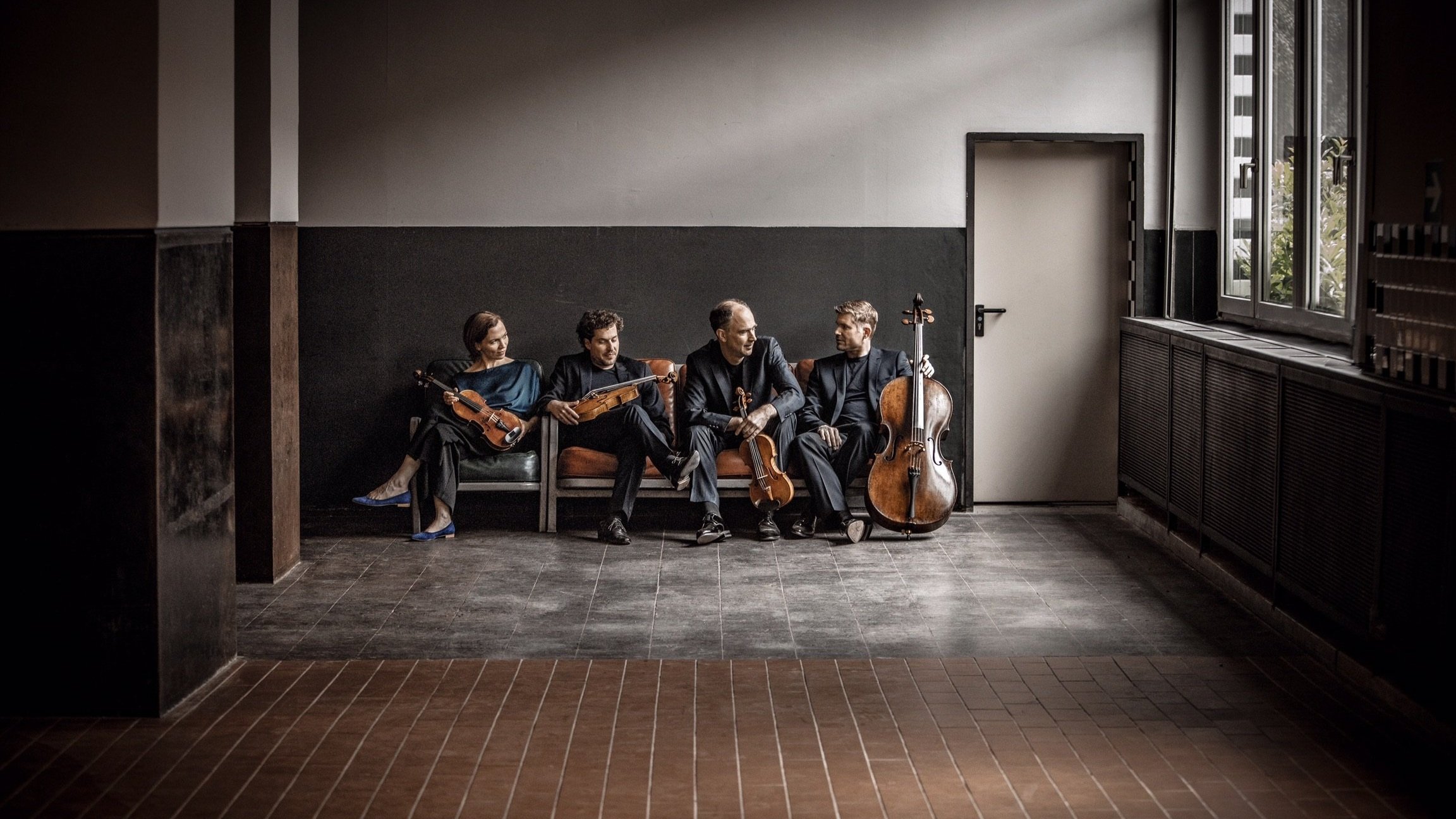
Signum Quartet
String Quartet
-
Florian Donderer & Annette Walther, violins
Xandi van Dijk, viola
Thomas Schmitz, violoncelloPerformances of unsparing expressivity, intimacy and vitality are hallmarks of the Signum Quartett, pairing music making of the subtlest order with playing of the highest intensity. The dramatic composition of their programmes is innovative and distinct, being realised with uncompromising perfection in interpretations of effortless transparency.
The quartet has been a welcome guest at the Wigmore Hall London, Concertgebouw Amsterdam, Philharmonie de Paris, Konzerthaus Vienna, Philharmonie Cologne, the Elbphilharmonie Hamburg, the Carnegie Hall and at the BBC Proms, with partners such as Nils Mönkemeyer, Dominique Horwitz, Jörg Widmann, Daniel Ottensamer, Nicolas Altstaedt and Elisabeth Leonskaja.
The Signum Quartett’s discography is a testament to their stylistic range: Next to standard works of the quartet literature, they have recorded works by Wolfgang Rihm, Thomas Adès, Jörg Widmann and Kevin Volans. Their recording of Erkki-Sven Tüür’s second string quartet “Lost Prayers” for ECM was rewarded Classical Album of the Year at the Estonian Music Awards 2021.
With the CD "Lebensmuth", the Signum Quartett completes its Schubert cycle for PENTATONE. This recording was awarded the Opus Klassik in 2024. The first album "Aus der Ferne" (Diapason D'Or, Opus Klassik) received several awards. "Ins stille Land" continues the cycle and deepens the exploration of the fascinating connection between string quartet and Lied. In 2025, ECM released “A Dark Flaring“ with compositions by South African composers from eight decades.
In 2015, the quartet launched its innovative social media project #quartweet, where composers of all ages and abilities are invited to tweet a short quartet of 140 notes or less on Twitter. The project has received much media attention and was featured on Deutschlandfunk, BBC In Tune and BR U-21. Contributing composers include Bruno Mantovani, Grawemeyer Award winners Brett Dean and Sebastian Currier and Pulitzer Prize winner Caroline Shaw.
In 2022, the quartet established its Bremen-based project SIGNUM open space, supported by Neustart Kultur. This is a space for rehearsals, recordings, workshops and education initiatives as well as an interactive exchange with the public. Additionally, interdisciplinary projects such as exhibitions, readings, dance and seminars on body awareness with renowned lecturers are offered.
In this open space, the Signum Quartett, whose violist is a native of South Africa, has also brought the history of South Africa to Bremen to mark the 30th anniversary of the end of apartheid: the ensemble has commissioned compositions from predominantly black South African composers such as Abel Selaocoe, Thandi Nthuli and Neo Muyanga, some of whose works also contain Jazz and Pop music as well as traditional African stylistic elements. These works are performed on tours worldwide and will be recorded.
In the 27/28 season, Enno Poppe will dedicate a new string quartet to the Signum Quartet, and together with video artist Lise Bruyneel, the immersive program ITIMACY – On the Traces of Leoš Janáček will be premiered.
6/2026 - PLEASE DESTROY ALL PREVIOUSLY DATED MATERIALS.
MODIFIED VERSIONS MUST BE APPROVED BY DISPEKER ARTISTS. -
November 13, 2020: Signum Quartet Releases ‘Ins Stille Land’
- SpotifyJune 7, 2019: Signum Quartet Nominated Twice For The Opus Klassik Awards
- Idagio -
2024 OPUS KLASSIK WINNER
The Opus Klassik Award for Best Chamber Music Recording Goes To ‘Lebensmuth’ by Signum Quartet
- Pentatone
THE STRAD RECOMMENDS: SIGNUM QUARTET: LEBENSMUTH
Four of Schubert’s wildest children, in a persuasive performance by the Signum Quartet that matches their youthful confidence and ambition. The virtues of this ensemble come to the fore in D887. Its combined tone is rich and well nourished, even in the ghostly shiverings of the opening movement, the gleam around the edge of the sound not diminishing the desolation of the bleak slow movement. The players’ coordination is breathtaking both in terms of ensemble and intonation, and their observation of dynamics and articulation guarantees that the work’s emotional impact is fully realised.
-David Threasher, The StradSIGNUM QUARTETT SUGGESTS NEW WAYS OF PLAYING SCHUBERT ON ‘INS STILLE LAND’
Broadly speaking, the quartet has selected and juxtaposed the songs and quartets to show the composer’s developing sense of alienation and death; in doing so, they suggest an affecting new way of playing and listening to Schubert…Prepare for a deeply moving experience.
– Laurence Vittes, Strings MagazineTHE BEST CLASSICAL RELEASES OF MARCH 2018
“The drama of this quartet is more intimate than in Rosamunde, but sounds just as gripping in the hands of the Cologne-based Signum Quartet. The ensemble demonstrates even finer calibrations of its expressive range on settings of five Schubert lieder — including the heart-rending “Die Götter Griechenlands” and the eponymous “Aus der Ferne” — arranged by its violist, Xandi van Dijk”
– Zev Kane, WQXRREVIEW: SIGNUM QUARTET, CHICHESTER CHAMBER CONCERTS
“The Signum Quartet played both works superbly, drawing every nuance out of the music with great finesse and boldness”
– Phil Hewitt, Worthing HeraldSIGNUM QUARTETT – SCHUBERT – AUS DER FERNE
The program makes audible the close connection between Schubert’s quartet and song compositions, which connection stems on the one hand from the fact that both kinds of compositions were performed in the same circles of friends and admirers of the too early diseased composer, and on the other hand arose from Schubert’s strong inclination for a secondary exploitation of songs in favor of instrumental compositions. To reuse melodies in his instrumental compositions secondarily.
– HighResAudio -
2027-29 Season Sample Programs
Lebensmuth II
Ludwig van Beethoven (1770-1827) String Quartet No. 16 in F major, Op. 135 (25 mins) OR
Joseph Haydn (1732-1809) String Quartet in F major, Op. 77 No. 2 Hob. III:82
Leoš Janácek (1854-1928) String Quartet No. 2 (1928) Intime Briefe (26 mins)
***
Franz Schubert (1797-1828) String Quartet in G major, D 887Beethoven's String Quartet Op. 135 (1826), his last completed quartet, radiates a cheerful clarity and conciliatory serenity despite its depth, combining classical form with a curious, alert view of life. Janáček's second quartet, "Intimate Letters" (1928), also his last work in this genre, blazes with passion and emotional immediacy, celebrating the power of intense feeling. Schubert's G major Quartet D. 887 (1826) unfolds in broad, bold harmonies and luminous lyricism, revealing an overwhelming energy that feels less like a farewell and more like creative abundance.
Tolstoy’s Walz II
Ludwig van Beethoven (1770-1827) String Quartet No. 1 in F major, Op. 18/1 (28 mins) OR
Joseph Haydn (1732-1809) String Quartet in F minor, Op. 55 No. 2 Hob. III:61 “Razor”
Leo Tolstoy (1828 - 1910) Waltz (arr. Xandi van Dijk)
Leoš Janácek (1854-1928) String Quartet No. 1 (1923) “Inspired by Tolstoy's Kreutzer Sonata”
***
Franz Schubert (1797-1828) String Quartet in D minor, D 810 “Death and the Maiden”Beethoven’s String Quartet Op. 18 No. 1 second movement is often linked to the tomb scene from Shakespeare’s Romeo and Juliet, capturing a dramatic progression from elegiac sorrow to shock and despair through operatic intensity and abrupt musical gestures. Janáček’s First String Quartet, inspired by Tolstoy’s The Kreutzer Sonata, both confront gendered violence, with Tolstoy exposing the social logic behind femicide and Janáček translating the story’s psychological terror into fragmented, emotionally charged music. Schubert’s Death and the Maiden explores the Romantic confrontation between youth and mortality, portraying death as both frightening and strangely consoling through stark contrasts and the calm inevitability of the slow movement’s theme.
Beethoven without Beethoven I: Conversations and Confessions
Wolfgang A. Mozart (1756-1791) String Quartet in A major, K. 464
Leos Janácek (1854-1928) String Quartet No. 1 (1923) "Inspired by Tolstoy's Kreutzer Sonata"
****
Johannes Brahms (1833-1897) String Quartet in C minor, Op. 51 No. 1Mozart's KV 464 became a central object of study for Beethoven and directly influenced his own Quartet Op. 18 No. 5, in which he takes up and further develops Mozart's clarity of form, art of variation, and contrapuntal balance. Janáček's first quartet, based on Tolstoy's "Kreutzer Sonata," is indirectly and directly linked to Beethoven's violin sonata of the same name and continues its expressive radicalism in a modern language. Finally, Brahms' Op. 51 No. 1 can be understood as a conscious engagement with Beethoven's quartet legacy, continuing its motivic density, contrapuntal rigor, and organic form in romantic intensity.
Beethoven without Beethoven II: Invention and Echo
Joseph Haydn (1732-1809) String Quartet in G major, Op. 77 No. 1, Hob. III:81
Jörg Widmann (*1973) String Quartet No. 7, "Beethoven-Studie II" (2019)
***
Felix Mendelssohn (1809-1847) String Quartet No. 2 in A minor, Op. 13Around 1800, Beethoven's Op. 18, in dialogue with Haydn's Op. 77, marked a decisive generational change, with Beethoven's early quartets still closely following his teacher's style, while Haydn's late style already pointed ahead to Beethoven. Mendelssohn's Quartet in A minor, Op. 13, composed shortly after Beethoven's death, is a conscious homage to his late quartets, with motivic allusions ("Muss es sein?"), recitative intensity, and a cyclical structure modeled on Op. 132. Jörg Widmann's 7th Quartet explicitly follows Beethoven's late style, further developing its contrasts, fragmentation, and formal radicalism in contemporary language.
Special programs
Breaking the Canon - all female programme
Maddalena Sirmen (1745-1818) String Quartet in F minor, Op. 3 No. 5
Vítězslava Kaprálová (1915-1940) String Quartet, Op. 8 (1935)
****
Fanny Hensel (1805-1847) String Quartet in E-flat major, H. 277 (1834)
Priaulx Rainier (1903-1986) Quartet for strings (1939)Fanny Mendelssohn, Priaulx Rainier, Vítězslava Kaprálová, and Maddalena Laura Sirmen were all pioneering women composers who built professional music careers in eras and environments where female composition was often discouraged or marginalized. Across different centuries and regions of Europe, they each expanded musical language in their own way—whether through Romantic song, modernist orchestral writing, nationalist-infused art music, or Classical-era instrumental virtuosity.
NB The quartet by Priaulx Rainier can be heard on our ECM album “a dark flaring”, and the Kaprálová will be released in September 2026 on Pentatone, together with the Janáček quartets.
Outreach | Introductory | Education Program
Rock Lounge 60
The Kinks You really got me *
Joseph Haydn (1732-1809) from String Quartet D major op 76 No. 5 Hob. III:79 Finale. Presto
Igor Stravinsky (1882-1971) from 3 Pieces for String Quartet (1914/1918): Danse
Cream Sunshine of your love*
Béla Bartók (1881-1945) from String Quartet No. 4 Sz. 91: Allegro molto
Matthijs van Dijk (*1983) (rage) rage against the
Led Zeppelin Heartbreaker*
Erwin Schulhoff (1894-1942) from Five Pieces for String Quartet: Alla tarantella
Radiohead Paranoid Android*
Ludwig van Beethoven (1770-1827) Große Fuge B-flat major op. 133
Duration ca. 60’, without intermission
*Arrangements: Matthijs van DijkRock Lounge 40 + 40 (with intermission)
based more around popular themes than only rock musicI
The Kinks You really got me *
Hugo Wolf (1860-1903) Italian Serenade
Priaulx Rainier (1903-1986) from Quartet for strings (1939): Presto spiritoso
Mokale Koapeng (1964) Komeng (2003)
Thomas Adès (*1971) from Arcadiana for string quartet Op. 12: “Et…” Tango mortale
Ludwig van Beethoven (1770-1827) from String Quartet D major op 18 No. 3: Presto (Tarantella)
Leoš Janácek (1854-1928) from String Quartet No. 1 (1923) “Kreutzer Sonata”: III. Con moto
Led Zeppelin Heartbreaker*
II
Cream Sunshine of your love*
Joseph Haydn (1732-1809) from String Quartet in D major Op. 20 No. 4 Hob.III:34
Menuetto alla zingarese
Igor Stravinsky (1882-1971) from 3 Pieces for String Quartet (1914/1918): Danse
Béla Bartók (1881-1945) from String Quartet No. 4 Sz. 91: Allegro molto
The Beatles Blackbird*
Erwin Schulhoff (1894-1942) Five Pieces for String Quartet (complete)
Radiohead Paranoid Android*
*Arrangements: Matthijs van DijkThe Schubert Experience
Note: This program can be customized with the repertoire from our PENTATONE albums, which is listed in detail at the end of this document. This includes a selection of three early quartets, the three late quartets and the Quartettsatz as well as 19 Lieder, arranged by Xandi van Dijk, violist of the Signum Quartet.
Program 1: Aus der Ferne/ From afar
This program takes the repertoire from the Signum’s multi-award winning concept album “Schubert: Aus der Ferne”, and with a few additions turns it into a concert program. This can also be done with their other two Schubert albums.
Wandrers Nachtlied, D768
String Quartet No. 12 in c minor, D 703 “Quartettsatz”
Im Frühling, D 882
Lied aus der Ferne, D 107
Hirtenmelodien aus Rosamunde, D797
String Quartet No. 8 in B-flat Major, D 112
***
Lachen und Weinen, D 777Die Götter Griechenlands, D 677
String Quartet No. 13 in A Minor ‘Rosamunde’, D804
Encore: Du bist die Ruh, D 776
Program 2: Late Quartets only
This takes Schubert’s two most-played quartets and contextualizes them with 4 selected Lieder. A similar program can be made with the Rosamunde Quartet D 804 and the G major quartet D 887.
Lied aus der Ferne, D 107
Die Götter Griechenlands, D 677
String Quartet No. 13 in A Minor ‘Rosamunde’, D804
***
Auf dem Wasser zu singen, D 774
Das Grab, D 330
String Quartet No. 14 in D Minor, D 810 “Der Tod und das Mädchen”
Encore: Du bist die Ruh, D 776
Program 3: All four late Quartets plus Lieder in two concerts
Concert 1
Lied aus der Ferne, D 107
String Quartet No. 13 in A Minor ‘Rosamunde’, D804
INTERVAL
Das Grab, D 330
String Quartet No. 14 in D Minor, D 810 “Der Tod und das Mädchen”
Concert 2
This selection of Lieder in the first half of this program is roughly 30 minutes duration. With the “Quartettsatz” the first half would be approximately 40 minutes long. This can be adapted if desired.
Lachen und Weinen, D 777
Die Götter Griechenlands, D 677
Ins stille Land, D 403
Frühlingsglaube, D 686
Auf dem Wasser zu singen, D 774
Wandrers Nachtlied, D768
String Quartet No. 12 in c minor, D 703 “Quartettsatz”
Schwanengesang, D 744
Das Weinen, D 926
Abendstern, D 806
An den Mond, D 259
Im Frühling, D 882
Lebensmuth (Fragment), D 937
An die Musik, D 547
INTERVAL
An die Nachtigall, D 497
String Quartet No. 15 in G major, D 887
Encore: Du bist die Ruh, D 776
SCHUBERT REPERTOIRE
String Quartet No. 1 in g minor, D 18
String Quartet No. 6 in D Major, D74
String Quartet No. 8 in B-flat Major, D 112
String Quartet No. 12 in c minor, D 703 “Quartettsatz”
String Quartet No. 13 in A Minor ‘Rosamunde’, D804
String Quartet No. 14 in D Minor, D 810 “Der Tod und das Mädchen”
String Quartet No. 15 in G major, D 887
and the following Lieder, arranged by Xandi van Dijk:
Lied aus der Ferne, D 107
An den Mond, D 259
Das Grab, D 330
Ins stille Land, D 403
An die Nachtigall, D 497
Der Tod und das Mädchen, D 531
An die Musik, D 547
Die Götter Griechenlands, D 677
Frühlingsglaube, D 686
Schwanengesang, D 744
Wandrers Nachtlied, D 768
Auf dem Wasser zu singen, D 774
Du bist die Ruh, D 776
Lachen und Weinen, D 777
Hirtenmelodien aus Rosamunde, D 797
Abendstern, D 806
Im Frühling, D 882
Das Weinen, D 926
Lebensmuth (Fragment), D 937
and
Hirtenmelodien aus Rosamunde, D797
*Updated June 2026